
Previous Module | Up One Level | Next Module
Most beats have at least one melody going on in the background along with the drums. In many cases, the key to a hit song is the catchy melody the beat has, so it’s only right that we begin the theory part of the course with melody.
Melodies are the basic foundation of every song, yet some people would find it to be the most difficult to compose. In this module, we’re going to learn more about the intricacies of melodies and how music theory can help you create your own.
But before we begin talking about melody, first let’s talk about notes.
Notes are the basic building blocks of music. If music is a language, a note would be the letter that forms the words and sentences. It might not seem useful now to learn which keys hit what notes, but trust me, it will make your life much easier in the future.
This is a piano.
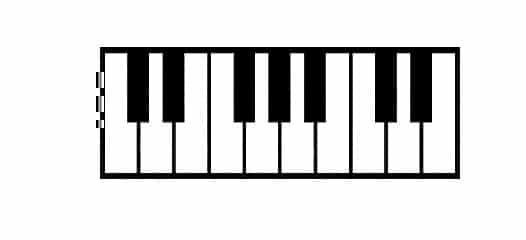
Each key on the piano represents a particular note, ranging from A to G. In Western music, C is considered to be the first note of the scale. In terms of “do re mi”, C is the equivalent of Do.
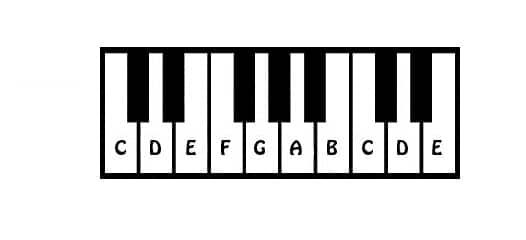
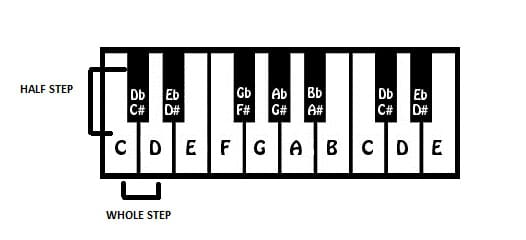
The black keys are sharps and flats — meaning a half step above the previous note (sharp) or a half step below the subsequent note (flat). In other words, the black key to the right of C can either be labelled as C# or Db.

(If you have a MIDI keyboard available, I suggest labeling the keys with tape to help you know the notes by heart.)
One thing to remember is that each note is a semitone apart from each other, or a half step. So the note D is a whole step away from C, and a half step away from C#. There’s no need to get into the specific science of musical frequencies and such, but it is important to know this.
The reason why I started with a quick explanation on notes is because they can be organized into scales. A scale is a set of musical notes that sound good together, and they are the basic palette of notes to use to form your melodies. Have you ever heard the phrase “off-key?” That’s when a note gets played that just doesn’t seem to fit with everything else.
Why is this relevant? Because in most instances, every song uses one particular scale. When you’re starting out to make a new beat, the very first thing that you have to do is to choose what scale you’re going to use because every note you use for that beat will be coming from that scale.
There are hundreds of different scales to choose from, but there are really just two scales that you need to learn by heart: the major scale, and the three minor scales. Each scale has seven notes in them (eight, which is the same note as the first one but just an octave higher). But don’t worry, you don’t have to memorize every note in each scale by heart — you only need to know the pattern that forms the scale, which we’ll talk about in a bit.
Scales also play a huge part in defining the mood of the song. For the most part, songs that use the major scale sound light and happy, and minor scales scale sound sadder, darker and are generally more melancholic (i.e. Jay-z’s “Holy Grail”). But we’ll talk about that later — for now, let’s go a little more in-depth about scales and how they relate to making beats.
Table of Contents
The Major Scale
The sequence of intervals in any major scale is as follows: root note, whole step, whole step, half step, whole step, whole step, whole step, half step to the root note.
That probably doesn’t make much sense to you right now, so let’s use an example. Let’s say we want to form a major scale in the key of C.
First, we start with the root note of C. To find the next note, you go up a whole step, which ends up with D. Go up another whole step and you’ll find the note E. Then you go up a half step. Since there’s no black notes in between E and F, the fourth note on the C major scale is F.
To find the next note, go up another whole step and you’ll get G. One whole step from G gets you A, and a whole step up from A gets you B. The last note is a half step away, and again, since there’s no black key in between B and C, a half step from B gets you the last note in the C major scale which is C.

So the keys of the C major scale is as follows: C, D, E, F, G, A, B then back to C. In other words, you’ll end up with the C major scale if you start from C and follow all the white keys. If you want to find the major scale in any other key, say, F, all you have to do is to use the C major scale as a reference and follow the pattern.
The Minor Scale
For the minor scale, the interval pattern is as follows: root note, whole step, half step, whole step, whole step, half step, whole step, whole step to the root note.
Again, to make more sense out of it let’s try forming a minor scale of our own, but this time let’s use the key of A.
First, we start with the root note of A. The next note in the minor scale is a whole step away, so we end up with B. The next note is a half step away, and since there’s no black key between B and C the third note in the scale is C.
The fourth and fifth notes are whole steps away from each other, which means the fourth and fifth notes in the A minor scale is D and E. A half step away from E and you’ll get F as the sixth note. The seventh note is a whole step away, which gets you G before starting over at A all over again.

In case you didn’t notice, once again the A minor key is comprised of all the white notes on your keyboard. You can use that as a reference in case you’re trying to figure out which notes are in any other minor scale.
Wait, Why Do They Have The Same Notes?
But wait, if both the C major scale and the A minor scales both contain the same exact notes, what makes them different from each other?
The difference is the tonic note, which is the tonal center of the scale and the main note every other note in the scale is referenced by. The tonic note is “home” — meaning most melodic phrases begin with that note, and doesn’t feel complete until it comes back to that note.
Take a listen to the C major and A minor scales played side by side, and notice that the overall feel of the melody is different even though they’re using the same exact notes.
(video example)
IMPORTANT TIP: Cheating With Your MIDI Keyboard
Now what if you want to use an E major scale? What about a G# minor scale? You can go ahead and figure out the notes in the scale by applying the formula… But admittedly, it can be a bitch to have to do this every time you want to select a new scale and remember if one particular note fits in the scale.
If you have a MIDI keyboard, chances are this won’t be a problem for you. Some keyboards have the ability to transpose notes by semitones. Basically, if you play the note for C3 while the keyboard is transposed by 4 semitones up, you won’t actually hear C3 but rather E3. Here’s a video example:
(video example)
As you can see, this makes playing scales much easier since you only have to remember two scales: the C major scale (which is pretty much all the white keys starting from C) and the A minor scale (which is pretty much all the white keys starting from A).
The Two Other Minor Scales
For some reason, there are 3 types of minor scales: the natural minor scale (which we just discussed above), the harmonic minor scale and the melodic minor scale.
These are almost the same as the minor scale, with a few fundamental differences. In the harmonic minor scale, the seventh note is raised by a half step (so the notes for the A harmonic minor scale would be A, B, C, D, E, F, G#, A).

The melodic minor scale, on the other hand, raises sixth and the seventh notes by a half step (so the notes would become A, B, C, D, E, F#, G#, A).

Personally speaking, it doesn’t matter as much which version of the minor scale you use — natural, melodic or harmonic minor — just play through the scale and see what sounds good to your ear. I personally tend to stick with the natural minor scale myself, while some songs even switch between the different minors within the song itself.
Application Of Theory
Now, there isn’t really an exact science to coming up with catchy melodies — this is where inspiration and experimentation comes in. But here’s a basic rule to remember: catchy melodies are all about motion — in other words, the movement of the notes in your melodic sequence.
A “melody” that only uses two subsequent notes back and forth doesn’t make for a very catchy beat. This is where your scales come in. The first thing you should do when starting out a beatmaking session is to choose which scale you’re going to use.
These notes are what you’ll be using the entire song, and your melody will move between the notes in your scale — that way, everything will sound like they fit with each other and you won’t have any notes that sound off-key.
Take a look at how notes in a scale can be used to form a simple, yet catchy melody:
(video example of Thrift Shop)
If you’re going for an upbeat, happy song, your best bet would be to choose a major scale. For the most part, songs that use the major scale sound light and happy whereas a minor scale would be a better fit if you’re going for a darker and/or sadder mood, a minor scale would probably be right up your alley.
But don’t be mistaken — that’s a general guideline, not exactly a rule. Sometimes, songs can use a minor scale but still sound happy (i.e. Macklemore’s “Thrift Shop” is in G# minor) or use a major scale but still sound sad (i.e. Alicia Keys’ “No One” is in E major) — more often than not, it’s the instrument you choose and the rhythm of your melody that determines the mood (more about rhythm in the next module).
It’s hard to find an example of a hip hop melody that was made with a major scale because most hip hop songs are composed in minor key. For example, Jay Z and Kanye West’s “Niggaz In Paris” uses the C harmonic minor scale.
(video example of “Niggaz In Paris”)
When you’re jamming around the scale, remember of the concept of the tonic note as being “home.” Think about the melody of “Twinkle Twinkle” and see how it starts at the tonic note of C, and then goes all the way up to A, before being brought back home to the original C. That last note resolves the melody and gives it a feeling of being “complete.”
(video example of Twinkle Twinkle)
Here’s another concept to remember: catchy melodies are a good mixture of steps, skips and leaps.
A step is when the next note you play is one note above or below the one you just played — for example, from C to D, or E to F. A skip is a bigger jump of 2 notes away — for example, from C to E, or E to G. And lastly, a leap is a melodic jump of four or more notes away — for example, C to F, A to D, or C to C.
(video example)
Don’t get caught up in the definitions — remember, we’re not concerned with being music theory experts here — but do use them to come up with interesting patterns. Take a look again at the melodies for “Thrift Shop” and “Niggaz In Paris” and you’ll see some interesting uses of steps, skips and leaps.
“Thrift Shop” leaped a whole octave (from G# to G#) before leaping to the third note down (D#), then quickly stepping down to the C#. It quickly leaps back up to the G#, leaps up to D# again, then skips down to B before bringing it back home to G#.
(video example of Thrift Shop, slowed down and analyzed in terms of steps, skips and leaps)
Previous Module | Up One Level | Next Module
